Built on Mathematical Patterns: The Fibonacci Sequence and the Golden Ratio
April 28, 2026 - Reading time: 7 minutes
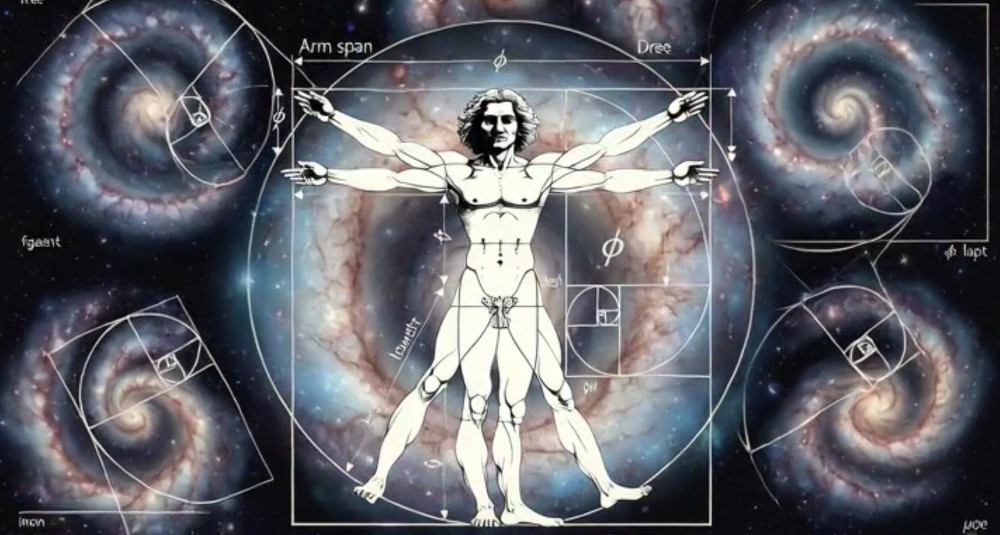
YouTube Video: You Are Built on Mathematical Patterns: The Fibonacci Numbers and the Golden Ratio
Whatever we study — from the smallest atoms to the largest galaxies — seems to follow underlying mathematical patterns. Among the most famous of these are the Fibonacci sequence and the Golden Ratio, both of which appear with surprising frequency throughout nature. They are everywhere!
The Fibonacci sequence is a series of numbers in which each term is the sum of the two preceding ones. It unfolds, starting from 1, as follows: 1, 2, 3, 5, 8, 13, 21, 34, and so on, continuing infinitely. As the sequence progresses, an interesting relationship emerges: when you divide one number by the one before it, the result approaches a constant value — approximately 1.62.
This number is known as the Golden Ratio. Some people call it the Divine Proportion because it can be found throughout the design of the Universe and everything in it. The Divine Proportion has been associated with beauty and harmony for thousands of years.
The Golden Ratio and the Fibonacci sequence appear in places both vast and microscopic. They can be seen in the spiral arms of galaxies, the arrangement of leaves on a stem, the patterns of seeds in a sunflower, and even in the structure of DNA. Across such an extraordinary range of scales, this recurring pattern feels almost uncanny.
What makes this even more fascinating is how these mathematical relationships show up in the human body.
Your hand creates a golden section in relation to your arm, as the ratio of your forearm to your hand is also 1.62, the Divine Proportion.
Then look at the proportions of your index finger. Each section of your index finger, from the tip to the base of the wrist, is larger than the preceding one by about the Fibonacci ratio of 1.62, also fitting the Fibonacci numbers 2, 3, 5 and 8. By this scale, your fingernail is 1 unit in length.
The human face, universally perceived as beautiful or balanced, conforms remarkably to Fibonacci ratios. The width of the mouth compared to the width of the nose approximates 1.62. The width of the face divided by the distance between the eyes is close to 1.62. The distance from the top of the head to the chin, divided by the distance from the eyes to the mouth, also yields 1.62.
Faces that subconsciously align with the Golden Ratio, such as those of classical sculptures or celebrated models, evoke harmony because our brains are wired to recognize proportion as a signal of genetic symmetry.
At the molecular core of life lies the DNA double helix, which also reflects Fibonacci geometry. The DNA molecule measures 34 angstroms in length for every full cycle of its double helix, while the width is 21 angstroms. The ratio 34:21 equals approximately 1.62. This geometric harmony within DNA suggests that the very blueprint of life is structured upon the same mathematical principles that define galaxies and seashells.
All such patterns hint at a deeper connection between mathematics and biological forms.
Skeptics often argue that humans are simply predisposed to see patterns everywhere—that our brains are wired to detect regularities, even when none truly exist. From this perspective, any pattern can be “found” by selectively choosing examples from a vast pool of possibilities. They may say, you see, the biology of some primates or some flowers do not always follow the Golden Ratio. So, this claim is not supported by everything you see in nature.
That argument would hold weight if we were drawing arbitrarily from an enormous, undifferentiated set of phenomena. But in practice, we don’t assign equal importance to everything we encounter. Treating all objects as equally significant for us reduces explanation to little more than appeals to randomness, where anything can be justified after the fact.
Human attention doesn’t work that way. We naturally prioritize certain features of the world—especially those that are biologically significant for us. We notice patterns that emerge within these meaningful subsets, not from an indiscriminate sweep of everything around us. And crucially, these subsets are limited: the structures of our bodies, for example, are not arbitrary fragments drawn from an infinite number of arbitrary objects around us.
You see, the parts of our hand don’t offer an unlimited range of possibilities to choose from. They have the primary importance for our existence. They are few in number. You see your hands in front of you at every moment. When a proportion like the Golden Ratio appears repeatedly across such a limited and meaningful set, it means something important in relation to humans, not just random coincidence.
It is precisely the importance of the structures in which the Golden Ratio appears repeatedly that makes it meaningful for us. The presence of this ratio is miraculous, as if abstract mathematical forms were woven into the fabric of existence. Do you see this?
This raises a compelling question: are these patterns based on the Golden Ratio simply efficient solutions shaped by evolution and physics? Well, physics does not offer much insight into why 1.62 is so special. Nor is there any clearly established evolutionary advantage that determines the dimensions of DNA or your hand, or face.
The Golden Ratio comes from pure mathematics — a concept discovered through logic and abstract thoughts, without any need required by nature. You can arrive at this number simply by exploring mathematical relationships — in your head.
This points to something fundamental about the structure of reality itself. It hints at a deeper design, like faint traces of an underlying framework of ideas woven into the fabric of our existence. In this sense, it forms part of the abstract scaffolding on which everything else rests, shaping the spectacle of the world as we perceive it.
It is part of the very stage where consciousness dances with matter, where infinity meets eternity, and where we find what we have always carried within.
Once something is truly understood, resistance loses its foundation.
- Link to the video: https://youtu.be/9lmE8dGrRA4?si=OMX7SUGX4oGcaxfd
- Style: Scientific Neo-Romanticism
Written for the YouTube channel by S. V. Chekanov
Comment
This is the full transcript of the YouTube video “Pragmatic Belief in God That Few Care About” in the Scientific Neo-Romanticism style created by the Designed World channel using the book “ The Designed World of Information: Unveiling the Incredible Realm Beyond ”, by Dr. Sergei V. Chekanov, 466 pages, ISBN: 9798990642836; Hardcover 9798990642843, eBook ISBN 9798990642829; Book webpage: https://ermislearn.org/designed-world/
Ads help maintain this website.