
The Mathematical Universe
January 24, 2026 Reading time: 3 minutes
You find yourself in this universe. Beneath its surface, natural laws — forged with astonishing precision. They co-exist in a delicate balance, interlocking one another. They make your appearance possible.
We uncover these laws through abstract ideas of mathematics. They manifest to us as traces of a deeper blueprint, or a hidden order that binds reality together. Simple formulas describe the workings of the cosmos, and this simplicity itself is puzzling. Why are these laws so elegant, so compact, so easily grasped? Long before experimental confirmation, these formulas often exist as pure abstractions, waiting to be recognized.
Quantum Entangled Lives
October 31, 2025 Reading time: 9 minutes
YouTube video "Our Quantum Entangled Lives".
If you know a bit about science, you've probably heard of one of its most fascinating phenomena: quantum entanglement. It's the kind of thing that makes even scientists pause and ask, "How can this be possible?"
Let's break it down. Imagine two separate microscopic particles, each with its own measurable properties-like energy and charge. Now, suppose we bring them together and make them interact. In that moment, a new quantum system emerges-one that can no longer be described simply by the individual properties of each particle. Their states become linked in such a way that measuring one instantly influences the other, regardless of how distant they may become.
Scientists and Belief
September 2, 2025 Reading time: 4 minutes
Introduction to the video "Science and Belief".
Maybe you've encountered a question like this: How can scientists believe in God, spirituality, or anything that doesn't seem scientific?
The answer is simple: we all believe in something. Scientists are no exception. While they trust scientific results, they also recognize that truth is not revealed by science alone. Many aspects of human experience lie outside the scope of science, yet they may still be real and shown to be true.
Unknowable Universes
August 14, 2025 Reading time: 6 minutes
YouTube Video Unknowable Universes
The laws of nature reveal astonishing beauty. Everyone knows the famous equation that links energy to mass-energy equals mass times the speed of light squared. Who doesn't? Scientists have measured this relation with extraordinary precision - within about 0.00004%, or roughly one part in 2.5 million.
The deeper question, however, is this: why does this formula look so simple? It's no more complicated than calculating the area of a circle, which equals π times a radius squared, where the constant π is known with extraordinary accuracy. This equation is exact; the only limitation lies in our ability to measure the radius. Why is it that the most fundamental equations governing our universe-the ones shaping reality itself-are often the simplest? In fact, the key laws that define our world, like those of gravity and electromagnetism, are remarkably straightforward. While some laws appear more complex, their role in shaping the universe is comparatively less significant.
The Quantum Fields Inside Us
June 19, 2025 Reading time: 5 minutes

Introduction to the video "The Quantum Fields Inside Us".
Our bodies are built as astonishing hierarchies of complex structures. We consist of different types of cells, each performing specialized tasks. These cells are composed of intricate nanomachines - long chains of molecules that carry out the essential functions of life.
Molecules themselves are built from atoms, which in turn are made up of nuclei and electrons. The nuclei consist of protons and neutrons, and these particles are composed of even smaller components: quarks and gluons.
Fields — the Invisible Architecture of the Universe
June 12, 2025 Reading time: 6 minutes
Introduction to YouTube video "Fields — the Invisible Architecture of the Universe".
This world is full of wonder. Attempts to understand the universe reveal a startling realization: the forces that govern its atoms and molecules remain, in many ways, beyond our full understanding. Science discovers how one phenomenon influences another, how different parts interact and connect. But what remains elusive is the deeper origin of the mechanism that links everything together.
This is the astonishing fact that you may not know: if we gathered all 8 billion people and removed the empty space within the atoms that make up our bodies, the remaining volume would fit inside a sugar cube - just about one cubic centimeter. This would be nuclear matter, similar to what exists in neutron stars. This is because 99.99% of an atom is just empty space.
The Rise of Scientific Neo-Romanticism
May 10, 2025 Reading time: 3 minutes
Romanticism, also known as the Romantic era or movement, emerged in Europe in the late 18th century as a powerful reaction against the rationalism of the Enlightenment and the mechanization brought on by the Industrial Revolution. More than a mere artistic trend, Romanticism was a sweeping intellectual and cultural movement that reshaped literature, art, music, and philosophy.
Mind, Death, and the Ocean of Infinite Possibilities
May 2, 2025 Reading time: 7 minutes

Introduction to the YouTube story Mind, Death, and the Ocean of Infinite Possibilities.
It has long been believed that the brain is a generator of thoughts - a computer that processes information received from our senses. It collects, organizes and modifies sensory data, builds experience, and ultimately produces bodily actions. For materialists, the mind is purely computational - capable of reasoning and problem-solving, or what is commonly referred to as intelligence, but nothing beyond that. In this view, consciousness is merely a subjective illusion generated by computations - much like the music that emerges from the spinning of a vinyl record. Our entire inner experience - our sense of self-awareness - is considered nothing more than an illusion.
The Incredible Voyage inside a Flower
April 24, 2025 Reading time: 4 minutes

The incredible voyage inside the flower (YouTube video story).
We find ourselves at a point where many explanations rooted solely in the randomness of the material world no longer suffice.
Imagine we are journeying through the heart of a beautiful flower. At first, we encounter biological cells forming their internal structure. Within these cells, intricate systems emerge - long, specialized molecules working together to carry out complex tasks. They convert chemical elements into energy, defend the organism from external threats, and enable reproduction. In essence, they animate matter.
What compels these molecules to perform such precisely organized operations? Why do they "care" about sustaining the life of an organism composed of otherwise lifeless matter? These questions remain beyond our current understanding.
Coincidence in Unimaginable Scales of the Universe
March 27, 2025 Reading time: 7 minutes
This story is created for the YouTube video with the title "Coincidence in Unimaginable Scales of the Universe".
In our world, a few numbers describe the sizes of the most important objects and phenomena. Among them are the sizes of a proton, DNA, a human, the Moon, the Earth, the Sun, the Solar System, the Galaxy, and the observable Universe - only a dozen numbers. Any coincidences among these numbers should spark interest because the number of possibilities is limited. One cannot dismiss strange events as mere play of chance or numerology without first examining the total number of random occurrences. And for a set of just a dozen numbers, meaningful coincidences typically indicate an underlying fundamental regularity.
The Fine Structure of the World — 137
March 12, 2025 Reading time: 7 minutes
A transcript of the YouTube video story The Fine Structure of the World.
If the universe did not emerge from an infinite chaos of random possibilities, then it must be woven with abstract patterns and intrinsic regularities - faint traces of a grand design. The laws of nature are but glimpses of a deeper blueprint, waiting to be uncovered. And we, beings with consciousness, guided by the same vision that shaped this design, are here to reveal its mysteries.
Sleep and Dreams: The Gates to the Unknown
March 6, 2025 Reading time: 7 minutes

Every day our consciousness "shuts off" for an extended period. We do not see, hear, or feel. It is as if we enter another world. Upon waking, one might ask: Where have I been all this time? And if you wake someone abruptly in the night, they often struggle to recognize which world they are in.
Sleep is so ordinary that we seldom question its true nature. And when we do this, science is here to provide the explanation: Sleep is a time for our body's recovery, a phase for "memory consolidation," during which the brain processes and stabilizes experiences. But is this a complete answer? How can science explain something to which it has no direct access - our inner self?
The Mysterious Pattern Inside the Pi (π) Constant
February 26, 2025 Reading time: 7 minutes
Watch YouTube video based on this story about the constant PI.
The universe around you holds secrets, often hidden within mathematical constants. These constants are so deeply woven into the fabric of existence that we frequently overlook just how extraordinary they truly are.
Consider the ratio of a circle's circumference to its diameter. This ratio is the constant known as π, with a value of approximately 3.14. It is an 'irrational' number, meaning that its decimal representation never ends, nor enters a repeating pattern. This constant cannot be expressed as a simple fraction of two integers. Could there be universes where π is different, say 4? Or perhaps universes where it is not constant at all, but instead a function of the diameter? Why does this world have this particular value of π?
A journey to infinity: Fractals
January 29, 2025 Reading time: 6 minutes
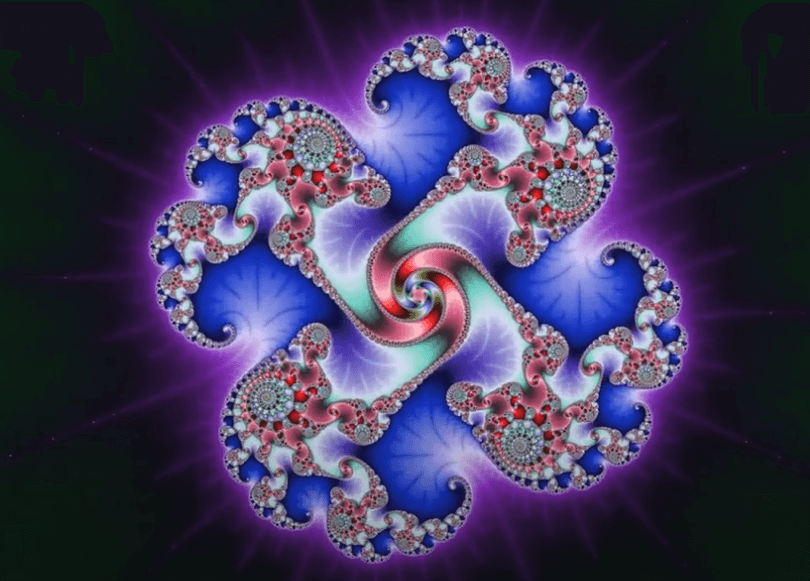
Imagine walking through a terrain that never repeats itself. It is a labyrinth of intricate patterns - mountains, branches, and valleys interwoven in endless complexity. No matter how much you zoom in, the details persist, evolving infinitely without repetition.
Such a journey compels you to ask two profound questions:
- What lies at the end of this road?
- Who or what created all of this?
The answer to the first question might appear simple at first glance. If it is proven - and you believe - that this road stretches infinitely, then every conceivable possibility must eventually arise. Shapes of all kinds will emerge along the way. You might even witness the letters of this story materializing before your eyes - or perhaps something resembling your own face. It is only a matter of time.
Ads help maintain this website.